This
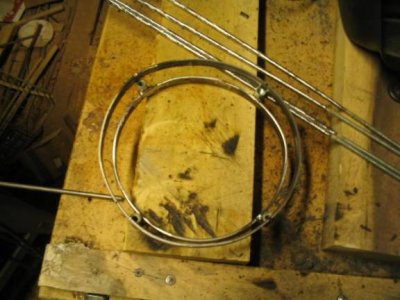
is a picture of the flesh ring and the
retaining ring. The retaining ring is the
flat stock ring on top. The retaining ring
is going to have the tensioning rods welded
to it. It is VERY important that the flesh
ring be the same size or even slightly
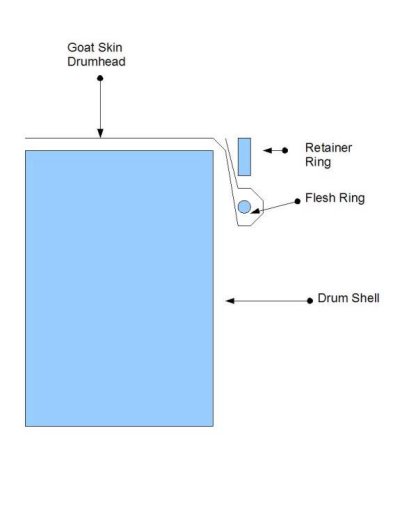
larger than the retaining ring. Here is a
crude drawing of how this works…

Notice that the skin wraps around the
shell, and under the flesh ring, and back
under the retaining ring. Now when the
retaining ring is pulled down by the
tensioning rods it locks the skin on to the
flesh ring. This is why it is important that
the flesh ring is the same size or a slight
bit larger than the retaining ring. If it
were smaller the skin would slip right
through…

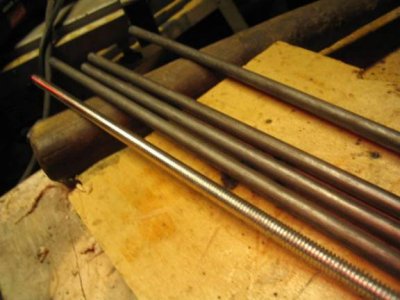
This is the material that the tensioning
rods are made from. On the left is a
material called all thread. It is basically
a threaded rod. I am going to cut this into
pieces about 7-8” long, and weld the
pieces to the ends of the rods to the right.
Those rods are ¼” cold rolled steel. You
can buy all of these materials from a home
improvement store, such as Home Depot here
in the U.S. If you have a steel distributor
in your area then you can save a
considerable amount of money buying from
them. In my area I can buy a 20’ long
section of this for $8 verses $2.87 for a
36” section from Home Depot. That is the
way to go if it is available to you.

I have now welded the threaded rod to the
ends of the tensioning rods… those are on
the right in this picture… (Another way to
do this is to cut the threads on the rods
your self instead of using the all thread
rod. The tool to cut them is fairly
inexpensive, but it is hard work and very
time consuming. If you can, welding all
thread on is the way to go.) In this step I
am going to weld the tensioning rods on to
the retaining ring. It is extremely
important to line up the rods with the
coupling nuts so I am marking the retaining
ring in line with the nuts so that I know
where to weld the rods…This is VITAL to a
nice looking drum!
|