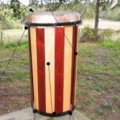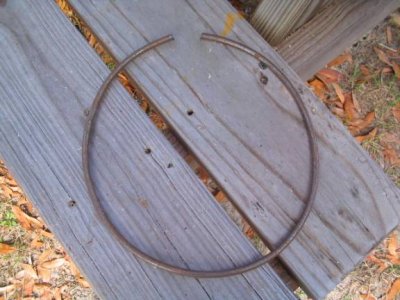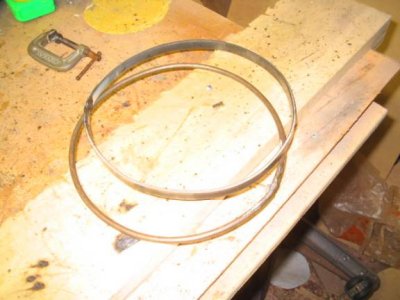
This is the flesh ring that goes around
the top of the drum and serves the purpose
of locking the drumhead in place. I show it
here because this is my last chance to use
the groove on the bottom of the drum to help
me shape the metal. I use ¼” cold rolled
steel for this and the tensioning rods. This
is fairly easy to bend and manipulate into
shape. I made this curve this far by bending
it around the bottom groove on the Drum
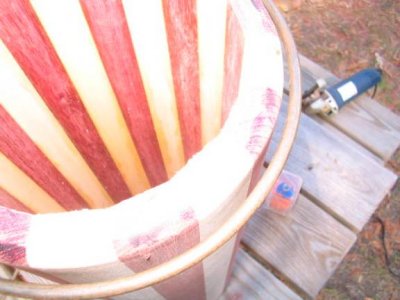
shell… This ring needs to be about ¼”
bigger than the outer width of the drum
shell. It must be able to move freely.

Notice how it matches the curve of the
shell with out touching. Bending around the
bottom groove did this. Again that was the
last chance for this, because now I am going
to be sanding the drum for finishing. I use
the pneumatic sander to 180 grit. This
creates a very silky smooth finish. The wood
grain begins to “glow” and become
translucent in a way at this stage. When I
have it sanded to 180, I use 220 grit and
block sand the shell with the direction of
the wood grain. This removes any swirl marks
left by the pneumatic sander, and really
polishes the wood. It will begin to shine
now. I use the compressed air to blow the
dust out of the wood grain and out of the
inside of the shell and wipe the whole shell
down with acetone, lacquer thinner, or
something similar. I do this to remove any
dust left from sanding and any oils left
from the skin on my hands. Now it is ready
to coat with wood finish. I use spray
polyurethane. It will dry to a hard, shiny,
glossy finish. There are a bunch of other
things that you can use for this, but keep
durability in mind. You can rub in a
finishing oil like boiled linseed oil, or
gun oil, or such. You can use a lacquer. You
can even paint the shell if you are using a
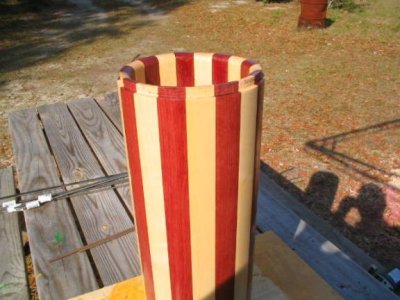
wood that is not to be the focus. Here is
the first coat of poly…

Notice the color change on the
purpleheart. It will begin turning more and
more purple as it is exposed to light and
the resins in wood begin to oxidize.

|