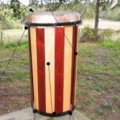
Once
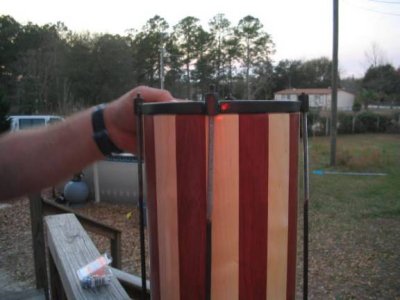
in the coupling nuts the rods should just
barely come out on the bottom. This allows
for the most freedom to tighten and tune the
drum when finished.

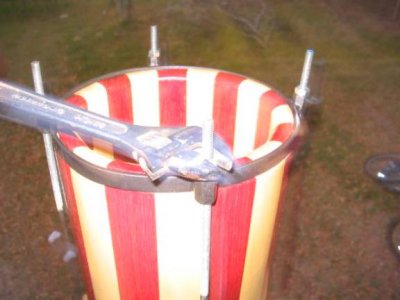
Now thread on some nuts. We will use them
to adjust and tighten and tune the drum to
it proper tone.

For the first bit of tightening I keep
the drum upside down. I do this so I can
adjust the rings as it pulls together. Be
very diligent about keeping the drum shell
centered in the rings. Keep the flesh ring
centered in the retaining ring. If you do
not do so the retaining ring may not
“bite” into the hide well enough. By
tightening evenly you should be able to keep
everything lined up and you will begin to
feel the tension on the nuts increase
slightly as the tightening of the nuts
starts pulling on the drumhead.
After it gets fairly tight you can move
it with out things shifting.
Then I flip the drum over and stand it up
on the tensioning rods, which have now
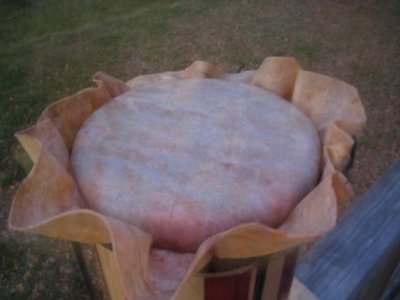
become legs. The top will now look like
this…

Notice that there is about an inch of
hide below the bearing edge of the drum
shell. This allows the Rings to be low
enough that you are not hitting your hands
on them when playing. That is much more
comfortable then having a smaller gap there.
If there is much more things seem to get a
bit out of proportion. While I have it in
this stage, I tighten the nuts little by
little, in an even manner. Watch the
retaining ring. You will want it to be as
level as possible so tighten accordingly. If
one side is too high, tighten the nuts on
that side a bit more than the other. By
doing so you can maintain a good level to
the rings, which makes the drum more
professionally done. Also it keeps the
pressure on the drumhead even and that leads
to better tone. I keep tightening until I
get a low toned “Bong” kind of sound.
Once there, allow the hide to dry for
several hours, or over night.
When the skin has dried thoroughly, it is
time to tune the drum. Start tightening the
nuts evenly all around the drum. As it gets
tighter the sound when tapped will go from a
low bong to a cleaner, tighter sound. Be
very careful to watch the retaining ring and
be sure that the drumhead is not slipping.
Tighten the head until you get the sound
that you are looking for. On the Kete drum
it should have nice and metallic sounds
around the edges, with deeper richer tones
in the center. These drums should be a bit
deeper in sound than the larger side of a
bongo drum. It should be higher and more of
a lead instrument than a conga. Snappy, and
clanging sounds are both quite with in the
range of the Kete.
Now that I have the drum tighten and
tuned and I am sure that there is no
slippage in the drumhead, I trim off the
excess hide that is above the retaining
ring, leaving a nice an neat edge. Now you
will notice that there is a slight bit of
hair stubble that has shown up since shaving
the hide. This is easily taken care of with
some 220-grit sandpaper. It will remove the
hair and it also removes any layers of skin
that need to come off. Be careful not to
over do it! You don’t want to sand through
the drumhead, my only purpose is to smooth
things out a bit. Now check the tuning over
the next several days as the skin may still
stretch a bit more. It will eventually
stabilize, and not require tuning often.
When it does it will be small ¼ turns on
the nuts to get it back into shape…
|