| This
is also time to check the sizing of the
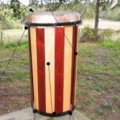
flesh ring. With the tensioning rods in
place you will likely find that the ring
will not fit well. Remember that the rings
are slightly oblong. Turn it inside the rods
to see if there is a place that it will fit
nicely. If not, now is the time to correct
it. It must go down flat against the
retaining ring.
This is the time to paint the metal parts
of the drum. If you can, powder coating is
extremely nice. I have done this in the past
and it makes a very professional looking
drum. I didn’t have this option available
for this tutorial, so we will be painting
the parts with black paint. I prefer a paint
that leaves a shiny “hammered” looking
finish. The texture hides some of the
imperfections a little.
After this we start working with the
goatskin.
When the goatskin comes it is dried and
stiff. In order to get it ready to mount it
needs to be soaked and shaved. I soak them
for several hours in water. I have recently
started adding bleach to help sanitize it a
bit. When you get a hairy goatskin is has a
funky smell. LOL It smells like a goat! What
else would you expect? After it has soaked I
wash it a bit to remove any sand or dirt
from hair… I have received them in various
states of cleanness.
After the soaking and washing it is now
time to shave the goatskin. Much stress and
concern is made over this step, but in truth
it is fairly simple. The shaving of the hide
can be done before or after mounting the
drumhead. I prefer before, because I do not
like to leave the hair on the drum. I have
seen Kete drums made this way but most are
not. Most Djembe drums are made with the
hair still on. Not my style! But if you want
to it is still simple. Just put these steps
in a different order.
To shave the skin I prepare 4-5 Bic
razors by breaking off the blade guard with
pliers and I sand the corners, so that there
are no harsh points that could gouge the
hide. Then I lay the hide across a very flat
surface. It cannot have bumps underneath
because these may cause you to accidentally
cut the hide and ruin it for the purpose of
a drumhead. It must be as flat as possible.
Skins for drums are too hard to come by to
be wasted, so carefully clear the area
underneath.

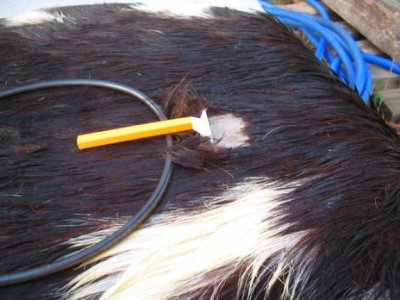
Then with smooth strokes with the handle
parallel with the hide begin to cut through
hair down to the skin. Once there, you be
amazed at how smoothly the hair comes off. I
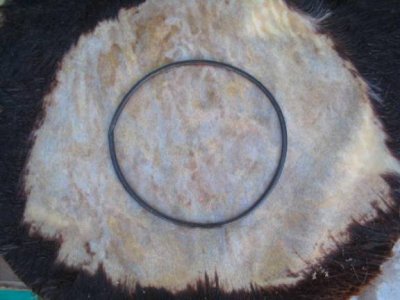
use the Flesh ring as a guide for how much I
need to shave. I leave about 6 inches or
shaved hide around the outside of the ring
as such…

I shaved this much area in about 5-10
minutes. Now this doesn’t leave the hide
perfectly cleanly shaved. The hair roots are
still there and will need to be dealt with
later after the skin has dried on the drum.
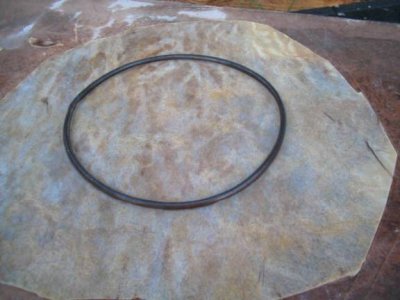
Now with scissors I cut the hide into a
rough circle remembering to leave plenty of
extra room…

|