|
Now that I've provided you
with a set of four basic loops, you should
be able to find some nice drum rhythms from
there. But there is another additional piece
of information, that I should give you
before you're on you're way creating your
own. I'd like to present to you two ways of
playing a measure. A combination of these
two can also be used, and as I repeatly say,
no rule in music is golden, but it is good
to learn some rules before you can break
them. So there are basically two ways
of filling in the measure.
In reggae, a measure is 4/4.
This means, there are four beats or counts
in a measure. In the steppers beat, a bass
drum hit is played on every count. So we
divide a measure in 4 equal parts, named
after their count: one, two, three, four.
But if you would be playing only on the
whole counts of a measure, then your rhythm
wouldn't really be that interesting.
Therefore, like the measures are divided in
four counts, also the counts are divided
into smaller sections. It's the way of
dividing the counts, that can make a whole
difference to your rhythm. They are both
equally used within reggae, and I would like
to present them both to you in this chapter.
I'm using a 130 BPM One Drop rhythm in this
chapter.
In the previous chapter I
asked you to take a special notice to the
bass drum. For the examples I will use in
this chapter, I would like to ask you, to
take some notion to the Hi Hat. The two
different kinds are called Straight or
Swing. Here they are:
STRAIGHT
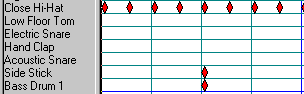
In a straight measure, you
dived a count by four notes. So you'll have
16 notes in one measure. To keep it a bit
simple, in the next example I divide the
measure into 8 different notes. As you can
see, there is a Hi Hat hit precisely between
every two counts.

LISTEN: EXAMPLE0007.MP3
| EXAMPLE0007.MID
The rhythm is straight on.
It is one straight line. You can also divide
the measure into 16, or even 32 different
notes but I will elaborate on these things
later on. Let's take a look at the second
rhythm:
SWING
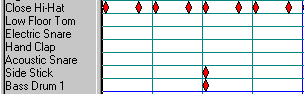
In swing, the measures are
not divided into 16 parts, but into 12 part.
The time between counts are not four, but
three. In a way, you could say it's a 3/4
measure within a 4/4/ measure. A One Drop in
traditional swing is programmed like in the
next example:

LISTEN: EXAMPLE0008.MP3
| EXAMPLE0008.MID
As you can see, you can't
really speak of a straight line here. The Hi
Hat hits between the counts are driven
towards the right. Like I didn't fill in the
2nd and the 4th count in the straight
rhythm, I didn't fill in the second one in
the swing rhythm.
Many artists have a
preference for either swing or straight.
Many also use both, but unmistakably there
is a big difference in the two types.
Because the straight rhythm is so straight
and solid, it's very powerful. And because
the swing is not straight, it gives a more
danceable feeling to the rhythm.
|